
news

CODAC attracts numerous partners to one-stop health service site

By
Alcoholism & Drug Abuse Weekly
July 14, 2025
SHARE:

A simple but empowering four word question to patients will guide the services to be delivered at CODAC Inc.’s new integrated health center in Rhode Island: “What do you need?”

When the 6-week-old center in Providence receives its full complement of on-site support staff in the coming months, opioid treatment program (OTP) patients will have access to a menu of services ranging from medical care and job training to food aid and tai chi classes. ADAW visited the state-of-the-art site (see “CODAC opens integrated health center, including OTP,” ADAW, May 26, 2025; https://doi.org/10.1002/adaw.34531) in late June, where staff members’ excitement over a realized vision was mixed with grave concern for the future of the many Medicaid beneficiaries who will be receiving services there.

As much as CODAC’s leadership knows that a one-stop shop for the services and supports that can strengthen recovery should be a major plus for its patient base, the newly signed 2025 federal budget reconciliation bill creates more immediate challenges over new bureaucratic hurdles in maintaining Medicaid coverage. More than 90% of CODAC’s patient population is Medicaid-insured.

“I have clients who are terrified,” said Ines Garcia, supervisor and lead peer recovery specialist at CODAC.

CODAC President and CEO Linda Hurley, who drove the establishment of the integrated center and cemented the relationships with the numerous health and government agencies that will have a presence there, realizes that all of CODAC’s staff will have to help patients navigate the potential impacts of an external threat.

“We have to work with folks,” Hurley said. “We have to talk to them about how we will address each possible outcome.”

Dignity, privacy, comfort

A tour of the 20,628-square-foot site that CODAC refers to as a fully integrated community health center(with use of the tagline “a new chapter in individualized, whole-person health care") illustrates that the organization is leaving no detail unattended in an effort to maximize patient dignity. The center’s OTP wing is equipped with six soundproofed stations for medication dispensing; CODAC vows to have no patient experience a wait time longer than five minutes, Hurley said.

Patients also will be able to meet with a nurse immediately to assess medical needs. Primary care, dental care, services to treat infectious diseases and gender-affirming care all will be available, and a community pharmacy will be located on site. Clients in need of food assistance will be able to receive a day’s worth of food on site and will be connected to local food pantries in their home area, Hurley said. She also worked hard to make sure that a local bus route had a scheduled morning stop just feet from the center.

Several CODAC initiatives will be housed at its Royal Little site(referring to the Royal Little Drive address), with plans to relocate the organization’s administrative functions there as well. The center houses CODAC’s HOPE (HeroinOpioid Prevention Effort) Initiative, a partnership between substance use clinicians and law enforcement officers to engage individuals at risk of overdose into treatment.

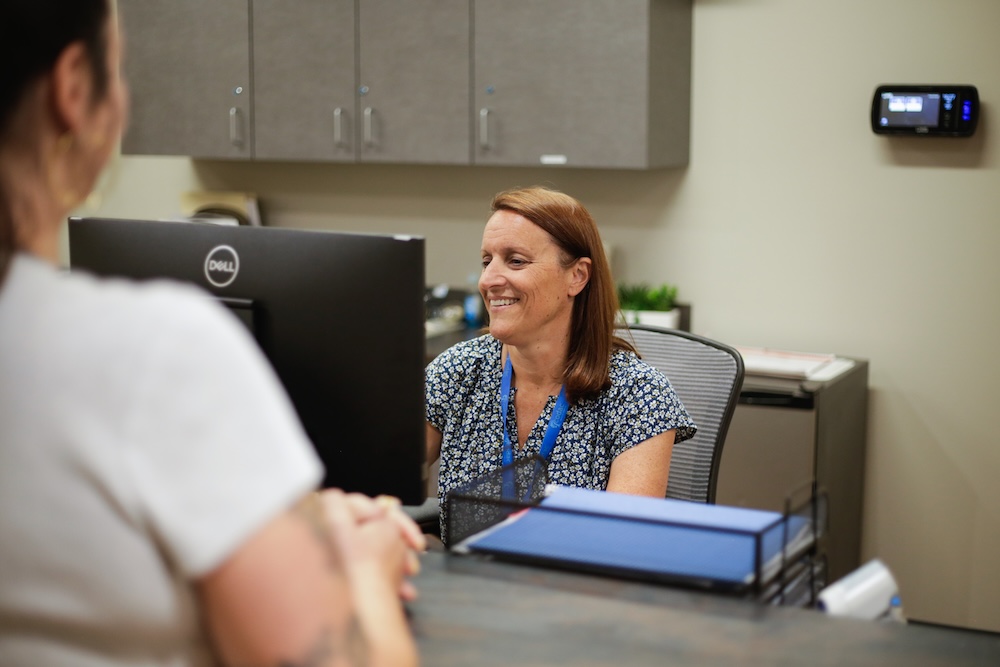
Peer recovery services also are available at the center, allowing OTP patients to see counselors at the same site where they receive methadone dosing. Garcia said her efforts focus on building trust and empowering clients — neither of which happen overnight.

“They come to us feeling hopeless, and I say, ‘You’re not hopeless. You’re strong. You survived. Now you need the courage to use that strength,’” Garcia said.

The health and government agencies that have agreed to house some operations at the new center all say their presence there will give them credibility with a patient population that has felt marginalized by authority figures in the past.

“Leveraging the trust that CODAC has established will serve us well, as we strive to get patients back to health care,” said Tracy Vadeboncoeur, director of behavioral health at Neighborhood Health Plan of Rhode Island, which manages benefits for the vast majority of CODAC’s patient base. “If someone hasn’t had a primary care visit, this is an opportunity to leverage the trust they have with the providers there.”

Neighborhood Health Plan staff will be located at the center every weekday, with representation from sales, member services and care management teams. “To have care managers on site also can help [CODAC] staff, to let them know what resources are available,”said Rena Sheehan, Neighborhood Health Plan’s vice president of clinical strategy.

Leaders with the health plan, which as of September will bring management of all of its substance use and mental health benefits in house, are enthusiastic about the potential to work with reentry services, as well as with the OB-GYN services that Hurley intends to locate at Royal Little. Vadeboncoeur characterized the Providence site as “a welcoming space where there is no wrong door.” Also within the next couple of months, the Rhode Island Department of Labor and Training will locate job coaching staff at the center. “Our administration and leadership has had a directive to bring our services into the community,” said Robert Kalaskowski, the state agency's assistant director of workforce development.

Kalaskowski said clients at the center will have access to a suite of services that includes resume writing, mock interviews and career counseling. The department also conducts workshops for employers, and Kalaskowski said it is important to communicate to employers that hiring a person in recovery can often be the best decision a company can make.

“[Hurley] is a force; she reached out to my director,” he said. "The thought was this is exactly the kind of work we need to be doing. It's what the customer deserves."

Mapping the future

While CODAC continues to build the network of services and supports that will be available at the center, leaders know they will have to be a reassuring presence to Medicaid clients who are rightfully fearful about the state of their benefits.

Hurley has been looking for the most accurate statewide data on how many plan members will be affected by newly enacted work requirements in the federal legislation. She and Garcia described the conundrum that would face individuals unable to afford both private health insurance and safe housing. For women with children, Hurley said, the potential loss of child care is frightening.

At a time of uncertainty regarding government resources, the case for operating a seamlessly integrated health center could be even more compelling from a cost-effectiveness standpoint. Hurley expects to address many audiences about the concept in the coming months, eager to show that this could represent the next wave in service delivery nationally.

Bottom Line…

In perilous times for publicly funded programming, CODAC Inc.'s new integrated health center could serve as a national model for efficient, patient-centered service.

"Patients will also be able to meet with a nurse immediately to assess medical needs. Primary care, dental care, services to treat infectious diseases and gender-affirming care. All will be available, and a community pharmacy will be located on site."

They come to us feeling hopeless, and I say, 'You're not hopeless. You're strong. You survived. Now you need the courage to use that strength.'"

Ines Garcia
CODAC Supervisor and Lead Peer Recovery Specialist

"For women with children, the potential loss of child care is frightening."

Linda Hurley
CODAC President and CEO